Guruji Journal
Surya Grahan, 12 August 2026: A Ketu Eclipse in Ashlesha — and Why India Will Not See It
Wednesday 12 August 2026 — 91.4% from London at 19:13 BST, invisible from India. The exact timings, why this is a Ketu eclipse rather than a Rahu one, and why sutak does not apply in India this time.
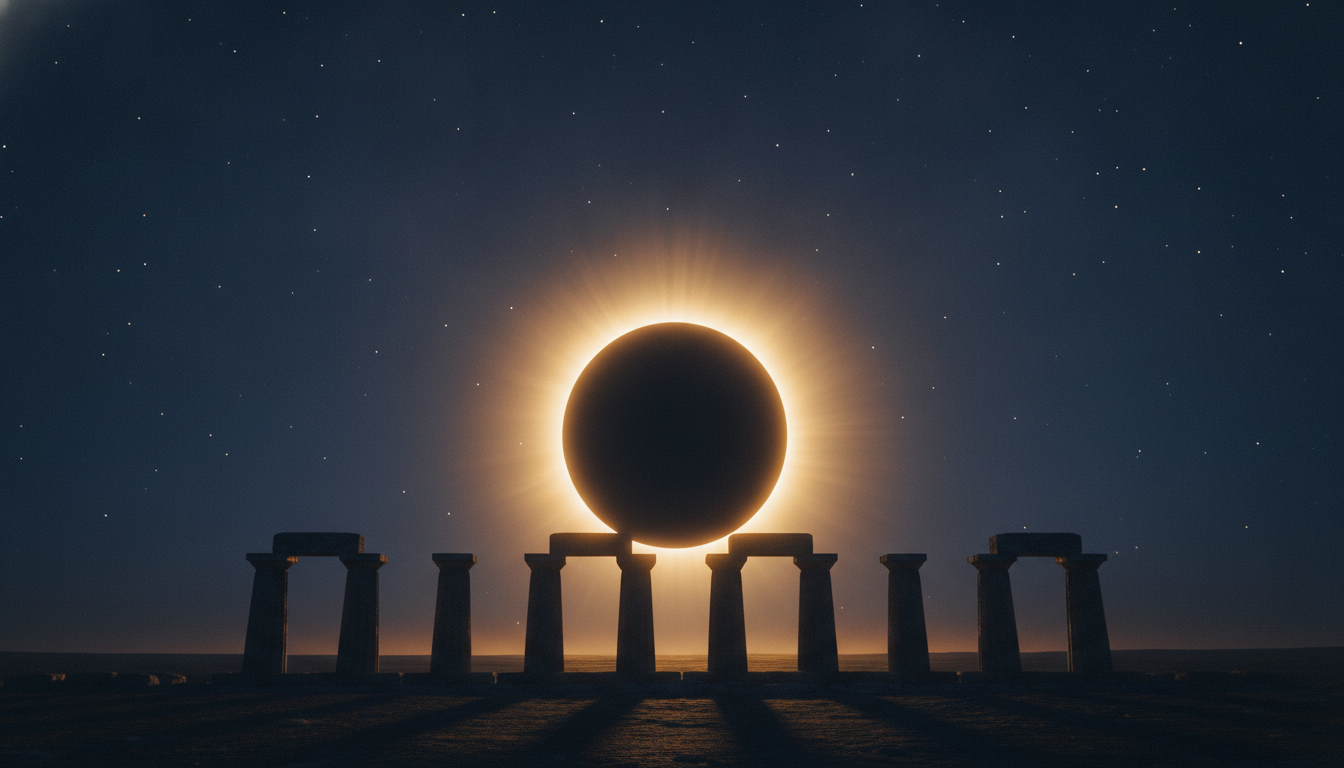
Surya Grahan, 12 August 2026: A Ketu Eclipse in Ashlesha — and Why India Will Not See It
On Wednesday 12 August 2026 the Moon passes across the face of the Sun. From London it covers 91.4% of the solar disc at 19:13 BST — the deepest eclipse seen from Britain since August 1999. From Delhi, Mumbai and Kolkata it will not be seen at all: the Sun is more than forty degrees below the horizon while it happens.
That single fact changes what this eclipse asks of you, and almost nothing written about it online makes the distinction. So let us do the astronomy first, honestly, and then the meaning.
The exact timings
All positions sidereal, Lahiri ayanamsa, computed rather than copied.
| Type | Total solar eclipse (Surya Grahan) |
| Global first contact | 12 Aug, 15:35 UT · 16:35 BST · 21:05 IST |
| Greatest eclipse | 12 Aug, 17:46 UT · 18:46 BST · 23:16 IST |
| Global last contact | 12 Aug, 19:58 UT · 13 Aug, 01:28 IST |
| Path of totality | Greenland, Iceland, northern Spain — greatest at 65.2°N, 25.1°W |
| Tithi | Amavasya |
| Weekday | Budhavara (Wednesday) — Mercury's day |
| Sun & Moon | 25°49′ Cancer — Ashlesha, pada 3 |
| Eclipsing node | Ketu (south node), about 10° away |
| Saros | Series 126, member 48 |
From the UK
| First contact (London) | 18:17 BST |
| Maximum — 91.4% covered | 19:13 BST |
| Last contact | 20:06 BST |
The Sun will be low, around ten degrees above the horizon at maximum. A deep eclipse with the Sun sinking towards the west is a genuinely rare sight in Britain.
From India
Not visible. At greatest eclipse the Sun sits 43° below the horizon at Delhi, 50° at Mumbai and 52° at Kolkata. It is the middle of the night.
The next solar eclipse visible from India is 2 August 2027.
What a grahan actually is
The Puranas tell it as a grudge. During the churning of the ocean, the asura Svarbhanu slipped into the line of devas and drank the amrita. The Sun and the Moon saw him and said so. Vishnu's discus took his head from his body — but the nectar had already passed his throat, so neither half could die. The head became Rahu, the body Ketu. Twice a year they catch the luminaries that betrayed them and swallow them. Having no body, Rahu cannot hold the Sun; it emerges again.
Underneath the story is precise observation. Eclipses happen only when a new or full Moon occurs near the points where the Moon's path crosses the Sun's — the lunar nodes. Indian astronomers identified those two points, gave them the names of the severed asura, and could predict eclipses from them. Rahu and Ketu are not planets and were never claimed to be. They are the two places where the paths cross, and where shadow becomes possible. (The same axis is what the Kaal Sarp Dosha industry is built on — worth reading before anyone sells you a remedy for it.)
This eclipse happens about ten degrees from the south node. It is a Ketu eclipse.
Why a Ketu eclipse reads differently from a Rahu one
The two ends of that axis are not interchangeable, and the classical distinction is unusually clean.
Rahu is the head without a body. Appetite with no capacity for satisfaction. Rahu transits tend to be described in terms of hunger — for status, for more, for the thing just out of reach. They expand, and they distort.
Ketu is the body without a head. It consumes and cannot retain, and it does not particularly want to. Ketu is the moksha karaka, the significator of release. Where Rahu grasps, Ketu drops. Its classical territory is renunciation, insight arriving without being reasoned for, the sudden loss of interest in something you had been chasing for years — and the residue of what is already finished.
So an eclipse at Ketu is not usefully read as a beginning. Its character is subtraction: something concludes, or is revealed to have concluded some time ago. That is not a misfortune. Much of what Ketu removes is what you had stopped wanting anyway.
Ashlesha, and a triple Mercury signature
The eclipse falls at 25°49′ Cancer, in Ashlesha — the nakshatra of the Nagas, the serpents. Its symbol is a coiled snake; its deity is the serpent host; its nature is the penetrating, unblinking gaze. Ashlesha gives genuine perceptiveness and, in its shadow, entanglement — the coil that holds as easily as it protects. It is the same serpent star honoured at Nag Panchami, which this year falls five days after the eclipse.
Now note who owns it. Ashlesha's ruling planet is Mercury. The eclipse falls on a Wednesday — Budhavara, Mercury's own weekday. And Mercury itself sits in Cancer, the very sign being eclipsed, at 10°53′.
Three separate significations, one hand. That is not a coincidence worth manufacturing — it is simply what the sky is doing, and it gives this eclipse a distinctly Mercurial texture: speech, correspondence, contracts, siblings, the nervous system, the things we tell ourselves. If something is going to conclude around this eclipse, it is more likely to conclude through a conversation, a document or a piece of information than through an event.
A further detail: Sun, Moon, Mercury and Jupiter all occupy Cancer — Mercury and Jupiter both in Pushya. Ketu sits in Leo at 6°, in Magha; Rahu opposite in Aquarius; and Saturn is retrograde in Pisces, in Revati.
One thing this eclipse is not: gandanta. The Sun at 25°49′ Cancer is 51 arc-minutes short of the gandanta zone that begins at 26°40′. You will see it described as a gandanta eclipse. It isn't — by less than a degree, but a miss is a miss.
Sutak: why it does not apply in India this time
Traditionally the sutak period before a solar eclipse runs twelve hours: cooked food is avoided, temples close, the elderly, unwell, children and pregnant women are excused from fasting, and the time is given to japa, meditation and stillness rather than activity. A bath follows the eclipse, and daan — giving — after it.
The classical rule is not usually stated as a rule at all, because it was too obvious to need saying: the observances of a grahan belong to the place where the grahan is seen. An eclipse invisible below the horizon casts no shadow on you. Panchangs have always drawn this line, which is why an eclipse visible only over the Pacific produces no sutak in Varanasi.
So:
- In India: the Sun is below the horizon throughout. No sutak. Wednesday 12 August is an ordinary Amavasya, with the usual pitru observances if you keep them.
- In the UK and Europe: the eclipse is plainly visible. If you keep sutak, the window runs from roughly 06:17 BST on 12 August until last contact at 20:06 BST.
If you are in Britain with family in India, you will be observing and they will not. That is correct, not a contradiction.
Where it lands in your chart
Read from your Moon sign (rashi), which is what Vedic astrology means by "your sign" — not the Sun sign used in Western horoscopes. (If you are new to nakshatras, the eclipse degree matters as much as the sign.) The eclipse is in Cancer, so:
| Moon sign | Eclipse falls in your | Traditionally touches |
|---|---|---|
| Aries | 4th house | home, mother, property, inner security |
| Taurus | 3rd house | siblings, courage, short journeys, communication |
| Gemini | 2nd house | money, speech, family, what you value |
| Cancer | 1st house | body, self, direction — the most personal placement |
| Leo | 12th house | loss, expenditure, sleep, retreat, foreign matters |
| Virgo | 11th house | gains, networks, elder siblings, hopes |
| Libra | 10th house | career, standing, public role |
| Scorpio | 9th house | father, dharma, teachers, long journeys |
| Sagittarius | 8th house | transformation, inheritance, hidden things |
| Capricorn | 7th house | marriage, partnership, contracts |
| Aquarius | 6th house | health, debts, service, adversaries |
| Pisces | 5th house | children, creativity, intellect, past merit |
Cancer Moons feel this most directly. Leo Moons carry Ketu itself and may find the twelfth-house theme — withdrawal, endings, sleep — unusually loud.
A word of caution, because you will read otherwise elsewhere. An eclipse is not a verdict. It is one transit, and it interacts with your dasha, your natal positions and the rest of the sky. Nobody can tell you from your Moon sign alone what will happen to you, and anybody selling certainty about it is selling something. Treat the house as a theme, not a forecast.
What to actually do
Very little, and that is the point.
If the eclipse is visible where you are, the tradition is consistent and undramatic: keep it quiet. Japa, meditation, stillness. Avoid beginning things — an eclipse is a poor muhurta for a launch, a signing or a wedding. Bathe afterwards. Give something away.
If you want a mantra for a Ketu eclipse in a Mercury nakshatra, the Ketu beeja — Om Sram Sreem Sroum Sah Ketave Namah — is the conventional choice, and the Mahamrityunjaya is never out of place.
And if the sky over Britain is clear on Wednesday evening, go outside and look west.
Never look at the Sun directly, even when it is ninety per cent covered. Ninety per cent of the Sun is still enough to burn your retina permanently, and it does not hurt while it happens. Use certified eclipse glasses, or project the image through a pinhole onto card. Sunglasses, smoked glass and exposed film are not safe.
The short version
A total solar eclipse on Wednesday 12 August 2026, at Ketu, in Ashlesha, on Mercury's day, with Mercury in the eclipsed sign. Visible from Britain at 91.4% — the deepest since 1999. Not visible from India at all, so no sutak there; the next one for India is 2 August 2027.
Ketu subtracts. Ashlesha and Mercury suggest it will do so through words, information or something already written. Whatever ends around it was, in all likelihood, finished a while ago.
All positions and timings computed with the Swiss Ephemeris, sidereal Lahiri.
Related reading
- Chandra Grahan, 28 August 2026: A Rahu Eclipse in Shatabhisha — Falling on Raksha Bandhan
- Jupiter in Cancer 2026: Exalted Guru's Gift to Every Rising Sign
- Jupiter in Gemini (2025–2026): Effects on Every Rising Sign
- Mercury Retrograde 2026: Dates, Effects & How to Survive It
Put this into practice: calculate your free Vedic birth chart or match two kundlis for marriage.